Beyond Pain Management: A Neurological & Mechanical Approach to Resolving Complex Regional Pain Syndrome (CRPS)
If you have been diagnosed with Complex Regional Pain Syndrome (CRPS), you are likely navigating a confusing and frustrating medical landscape. You may have been told that your nervous system is “misfiring,” or that your pain is disproportionate to your original injury.
Standard medical advice often focuses on managing this pain with medications—corticosteroids, nerve blockers, or gabapentin—and waiting for the “storm” to pass. But for many patients, management is not enough.
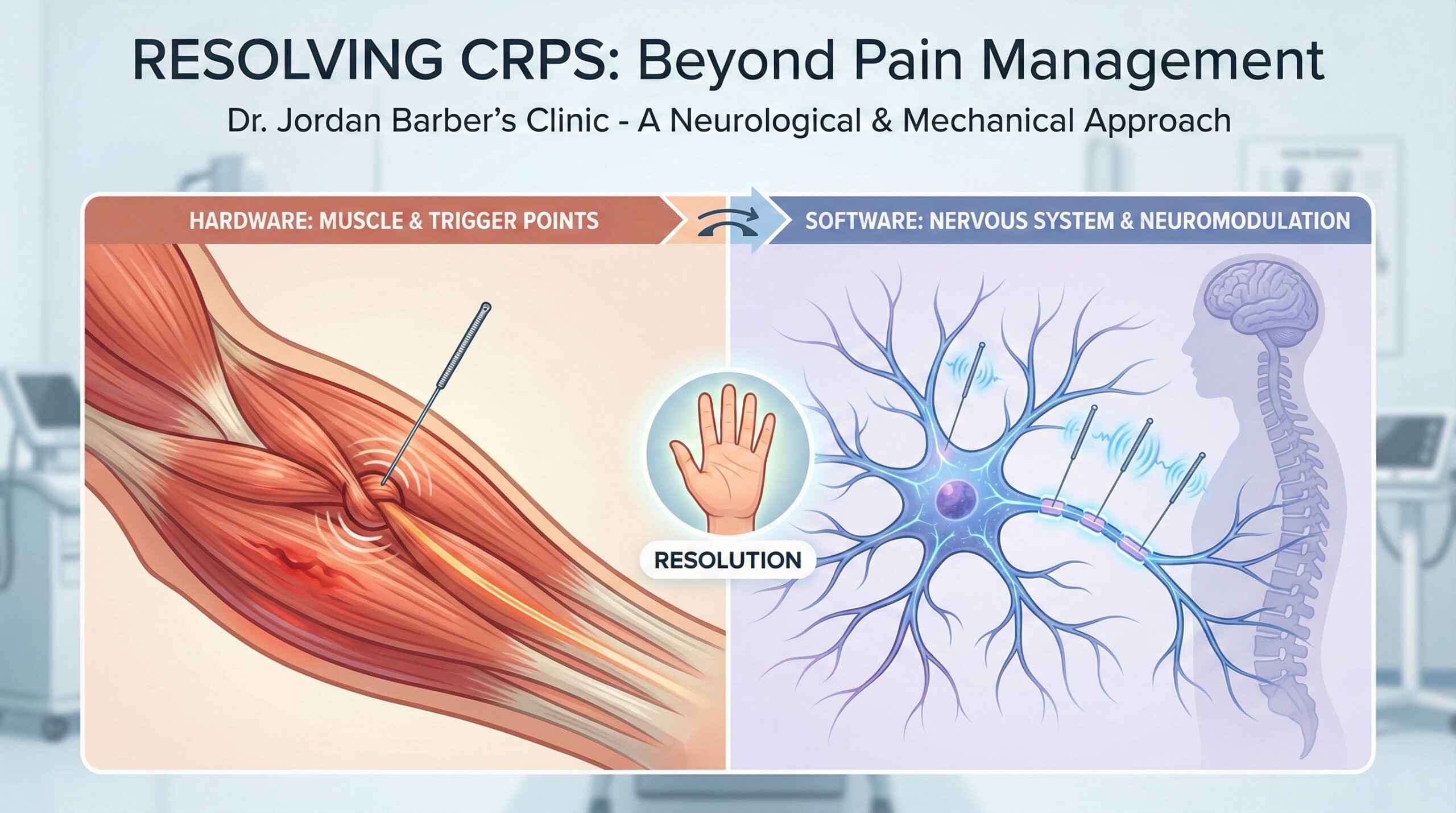
At Dr. Jordan Barber’s Clinic, we believe that to treat CRPS effectively, you must understand the mechanism driving it. It is not just “pain”; it is a malfunction of both your local tissue (the Hardware) and your central nervous system (the Software).
Why Conventional Treatments Often Stall
The conventional standard of care for CRPS focuses heavily on pharmaceutical intervention. While these treatments aim to dampen symptoms, they often fail to address the root physiological drivers of the condition.
According to a comprehensive review in Pain and Therapy, while corticosteroids and NSAIDs may offer relief in the acute (early) inflammatory phase, they show limited efficacy in resolving chronic CRPS symptoms once the condition has entrenched itself in the central nervous system [1].
Furthermore, standard physical therapy can sometimes backfire if it is too aggressive. Forcing movement through a hypersensitive limb without first down-regulating the nervous system can increase “guarding”—a protective mechanism where muscles tighten further, reducing blood flow and increasing pain.
Understanding the Mechanism: The “Hardware” and “Software” Loop
To resolve CRPS, we have to treat two distinct problems simultaneously:
The Peripheral Driver (Hardware): The physical muscle tissue where the original injury occurred.
The Central Driver (Software): The sympathetic nervous system, which is stuck in a “fight or flight” loop.
1. The Hardware: Ischemia and Trigger Points
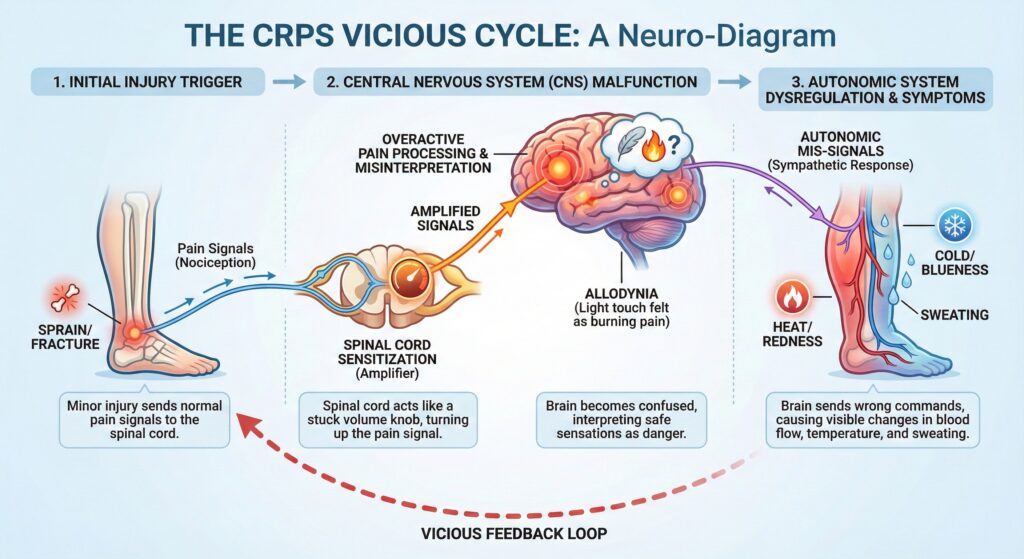
CRPS often begins with a minor injury—a fracture, sprain, or surgery. Even after the bone or ligament heals, the surrounding muscles often remain in a state of crisis. They develop Myofascial Trigger Points—tight, contracted knots of muscle fiber.
These trigger points compress blood vessels, causing local ischemia (lack of oxygen). When muscle tissue is starved of oxygen, it becomes acidic and releases inflammatory chemicals that constantly signal “DANGER” to the spinal cord. This is a physical problem that medication cannot untie.
2. The Software: Central Sensitization
When the spinal cord is bombarded by these danger signals for too long, it changes how it processes information. It becomes “sensitized.” This is why a light touch from a bedsheet might feel like a blowtorch (allodynia). Your nervous system has lowered its threshold for firing, interpreting safe signals as dangerous ones.
At Dr. Barber’s Clinic, we use a targeted, dual-approach to break this cycle.
Treating the Hardware with Dry Needling
Dry Needling is the most precise tool available to treat the peripheral “hardware” issues of CRPS. Unlike massage, which presses on sensitive tissue, dry needling involves inserting a thin, sterile filament needle directly into the dysfunctional trigger point.
This mechanical stimulation creates a “local twitch response,” which forces the contracted muscle to release. A study published in the International Journal of Sports Physical Therapy confirms that dry needling effectively disrupts dysfunctional motor endplates and improves blood flow (re-oxygenation) to the hypoxic tissue [2]. By physically releasing the muscle, we stop the constant stream of danger signals being sent to the brain.
Treating the Software with Electro-Acupuncture
Once the muscle tension is addressed, we must calm the nervous system. We utilize Neurological-Based Electro-Acupuncture, a form of neuromodulation.
By applying specific electrical frequencies to needles inserted near nerve trunks, we can communicate directly with the spinal cord. This process triggers the release of endogenous opioids (the body’s natural painkillers) and down-regulates the overactive sympathetic nervous system.
Research in the Journal of Pain Research has shown that electro-acupuncture can alleviate mechanical allodynia (pain from touch) by suppressing specific inflammatory signaling pathways in the spinal cord [3]. Essentially, we are hacking the “software” to turn off the false alarm, allowing your body to exit the “fight or flight” state and enter a state of healing.
I Don’t Guess. I Assess.
The generalist approach of “wait and see” or “medicate and manage” is rarely sufficient for a condition as complex as CRPS. You need a provider who understands the intricate relationship between orthopedic mechanics and neurological function.
My approach is simple but rigorous:
Map the kinetic chains contributing to the pain.
Correct the tissue hypoxia and trigger points with Dry Needling.
Modulate the nervous system with Electro-Acupuncture.
Take the Next Step Toward Resolution
You do not have to accept chronic management as your only option. If standard care has failed to resolve your CRPS, it is time to look at the problem through a different lens.
Taylor SS, Noor N, Urits I, et al. Complex Regional Pain Syndrome: A Comprehensive Review. Pain Ther. 2021;10(2):875-892.
Unverzagt C, Berglund K, Thomas JJ. Dry Needling for Myofascial Trigger Point Pain: A Clinical Commentary. Int J Sports Phys Ther. 2015;10(3):402-418.
Hu B, Diao Y, et al. Electroacupuncture Alleviates Mechanical Allodynia in a Rat Model of Complex Regional Pain Syndrome Type-I via Suppressing Spinal CXCL12/CXCR4 Signaling. J Pain Res. 2020;13:2597-2609.
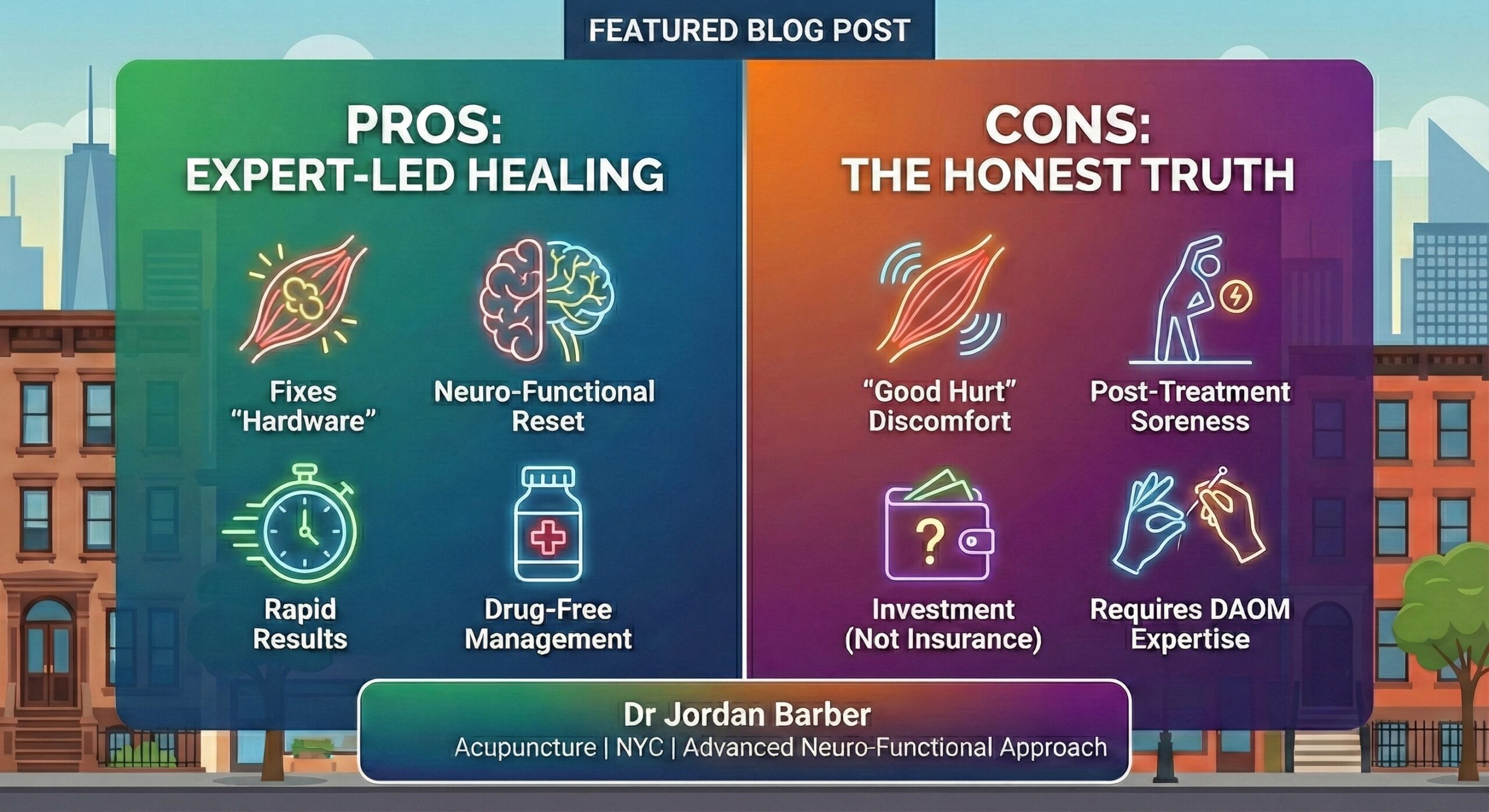
If you have Googled “dry needling pros and cons,” you’ve likely found generic lists telling you that it “might hurt” or “isn’t always covered by insurance.” While true, these lists miss the…
If you’ve ever leaked a little urine when you laugh, sneeze, or jump, you’re not alone. This is called stress urinary incontinence, and it affects millions of women—especially after childbirth, surgery,…
Introduction Gastrointestinal (GI) disorders such as constipation, bloating, and abdominal pain are often attributed to diet, stress, or gut microbiome imbalances. However, one crucial factor that is frequently overlooked is…
118 W. 72nd, Rear Lobby, Upper West Side, NY 10023 Evidence-based acupuncture and dry needling on the Upper West Side, NYC. From chronic pain, headaches, and pelvic floor dysfunction, Dr. Jordan Barber integrates the highest level of training with compassionate care to help you thrive. Disclaimer: This site does not provide medical advice. Always consult a qualified healthcare professional before making changes to your health. Read our full disclaimer
Quick Links
Got Questions?
Limited spots available each week book now to reserve yours