Dorsalgia Is Not a Diagnosis. It’s a Symptom. (And Why “Seeing” It on Ultrasound Won’t Fix It)
Why generic back pain treatments fail—and the truth about expensive ultrasound diagnostics vs. actual root-cause resolution.
If you have visited a general practitioner or a physical therapy clinic in NYC recently, you might have seen the word “Dorsalgia” on your paperwork. It sounds specific, serious, and authoritative.
In reality, “Dorsalgia” is just the Latin word for “Back Pain.” It is a generic billing code (M54.9), not an explanation. It tells you where you hurt, but it tells you absolutely nothing about why.
To “diagnose” this vague condition, many modern clinics will immediately reach for a Diagnostic Ultrasound. They will scan your lower back, point to a grey fuzzy spot on a screen, and tell you that is the problem. It looks impressive—high-tech screens, fancy probes, and a “guided” procedure.
But here is the uncomfortable truth: In the vast majority of low back pain cases, that ultrasound is unnecessary. It often serves to increase the billable cost of your visit (especially in out-of-network settings) under the illusion of adding value.
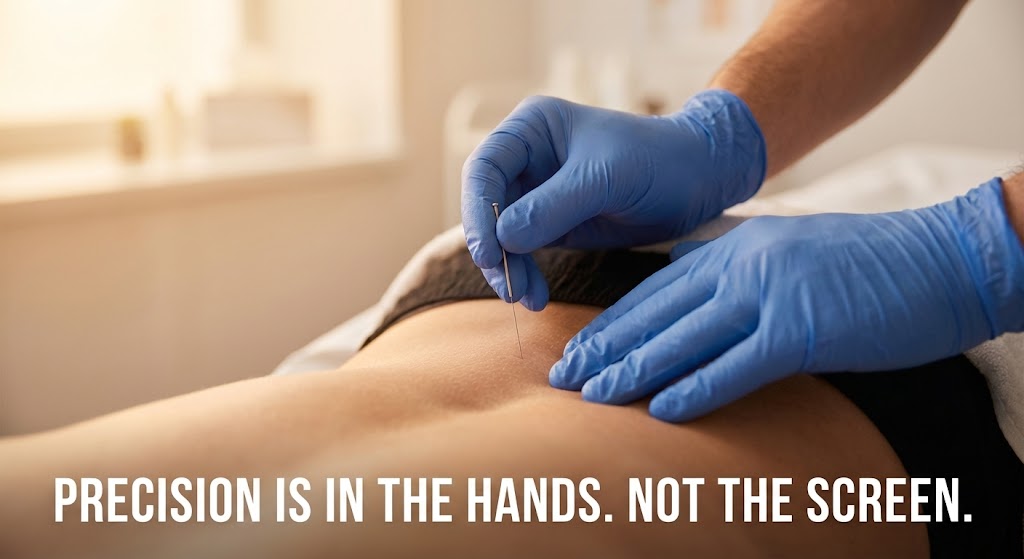
At Dr. Barber’s clinic, we prefer transparency over theater. We don’t just “look” at your pain; we feel it, find it, and fix it. Here is why we prioritize Tactile Precision over unnecessary imaging.
1. The Expert’s Stance (We Wrote the Research)
We aren’t anti-technology. In fact, Dr. Barber has published peer-reviewed research on the use of ultrasound-guided dry needling. We know exactly how to use it, and we know exactly what its limits are.
Because we understand the science, we also understand the necessity. Research consistently shows that for most standard musculoskeletal conditions, ultrasound-guided needling does not yield significantly better outcomes than palpation-guided needling performed by a skilled clinician.¹
If the outcome is the same, why should you pay for the expensive “add-on”? We would use technology when safety demands it (like deep needling near the lungs), but for the lower back, your wallet shouldn’t suffer for a fancy visual.
2. You Can’t “See” a Stiffness Problem
An ultrasound is great at seeing fluid or tears, but it is terrible at measuring stiffness or mobility.
A trigger point is a 3-dimensional knot deep within the muscle belly (like the multifidus or quadratus lumborum). To truly release it, a clinician needs to feel the resistance of the tissue (tactile feedback).
When a provider relies entirely on a screen, they lose that tactile connection. They might hit the “target” visually, but miss the subtle twitch response that signals a successful release. At Dr. Barber’s clinic, we use advanced palpation-based Dry Needling. We feel exactly where the muscle is “stuck” and release it mechanically.
3. The “Software” Glitch (Why Scans Miss the Point)
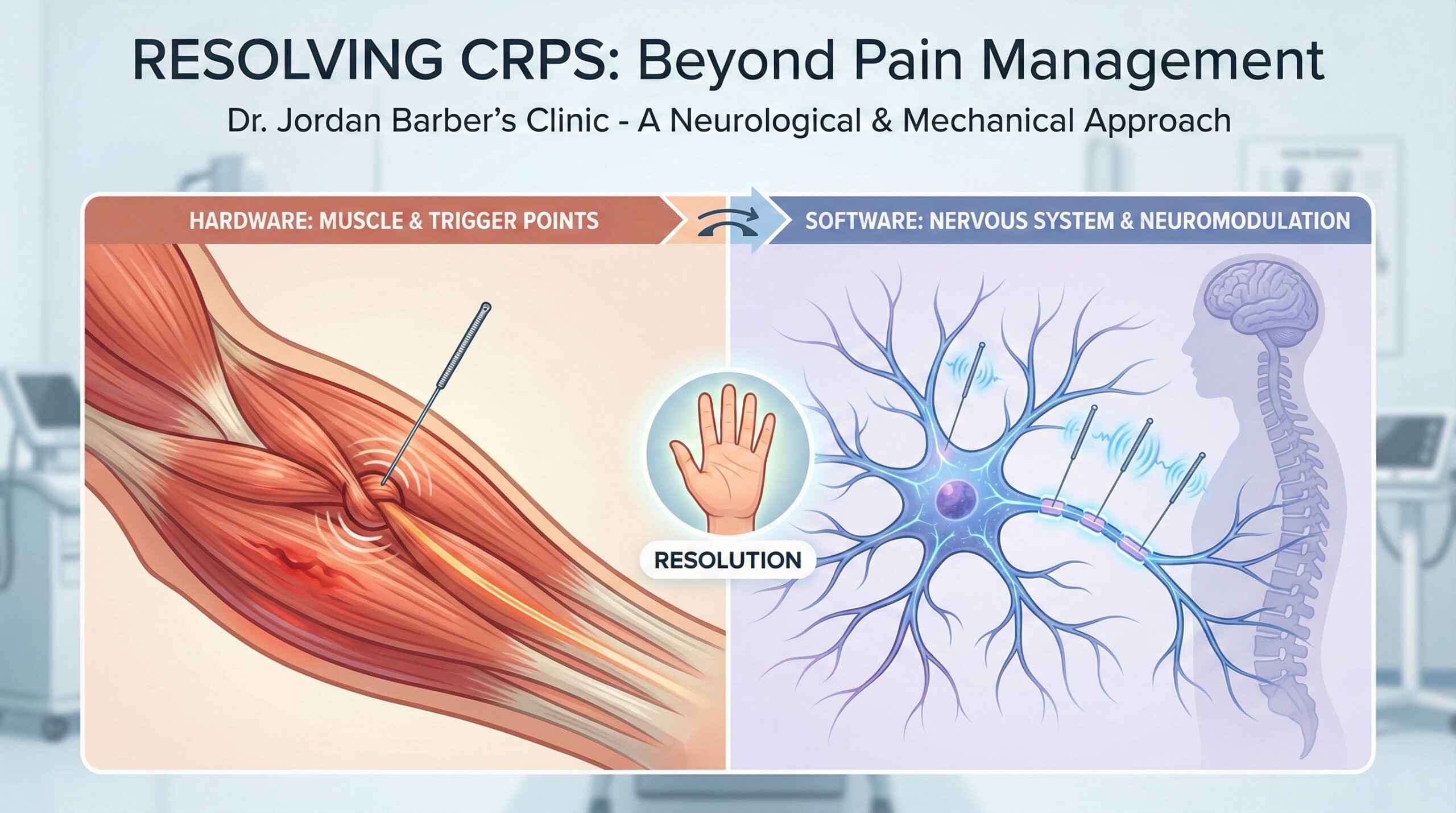
Chronic back pain is rarely just a “hardware” issue (a torn muscle). It is usually a “software” issue (a sensitized nervous system).
This is called Central Sensitization. Your nervous system keeps sending pain signals long after the tissue has healed. You can scan that back all day, and the ultrasound will look “normal,” but you will still be in agony.
We use Electro-Acupuncture (Neuromodulation) to target this invisible problem. By applying specific electrical frequencies to the spinal nerve roots, we hack the system, releasing natural painkillers (endogenous opioids) and turning down the volume on your pain. You cannot see a sensitized nerve on a screen, but you can certainly treat it.
4. Results Over Revenue
Many clinics use “image guidance” to justify higher reimbursement rates from insurance companies. It creates a perception of “advanced care.”
We believe advanced care is defined by results, not props.
We Don’t Guess: We use orthopedic assessment and palpation to find the root cause.
We Don’t Up-Charge: We use the tools that are clinically necessary, not just the ones that bill well.
We Fix the System: We integrate Dry Needling, Acupuncture, and Neuromodulation to treat the whole patient.
The Dr. Barber Difference: “Precision You Can Feel.”
We treat “Dorsalgia” by ignoring the label and treating the human.
At our Upper West Side clinic, we specialize in the “unsolvable” cases—the patients who have had the MRI, the ultrasound, and the injections, but are still in pain. We don’t need a monitor to tell us you’re hurting. We need your feedback and our hands-on expertise to make it stop.
Stop settling for expensive pictures of your pain. Get a solution.
Elbastı MŞ, Yentür SB. Comparison of the Effectiveness of Blinded Versus Ultrasound-Guided Trigger Point Injections into the Trapezius Muscle in Patients with Fibromyalgia. Istanbul Med J. 2024;25(1):16-21. Study Link
Wang X, Yang J, Li Y, et al. Efficacy of electroacupuncture compared to standard and manual needling therapy for nonspecific low back pain: A systematic review and meta-analysis. Biomed Res Int. 2024;2024:8839210. PubMed Link
Kulzhanishvili N, Kotorashvili A, Datukishvili N. Efficacy of Dry Needling for Chronic Low Back Pain: A Systematic Review and Meta-analysis of Randomized Controlled Trials. Altern Ther Health Med. 2023;29(8):110-120. PubMed Link
Griswold D, Learman K, O’Halloran B, Cleland JA. Safety Considerations When Dry Needling the Multifidi in the Thoracolumbar Region: A Cadaveric Study. Int J Sports Phys Ther. 2023;18(6):1427-1436. PubMed Link
Knee pain can be a significant obstacle, limiting your mobility and enjoyment of daily life, especially in a vibrant city like New York. Whether it’s a sharp pain from an…
If you have been diagnosed with Complex Regional Pain Syndrome (CRPS), you are likely navigating a confusing and frustrating medical landscape. You may have been told that your nervous system…
Understanding the complex interplay between our body’s systems can be a fascinating journey. Especially when it comes to seemingly unrelated conditions like constipation and hip pain. Does constipation cause hip…
118 W. 72nd, Rear Lobby, Upper West Side, NY 10023 Evidence-based acupuncture and dry needling on the Upper West Side, NYC. From chronic pain, headaches, and pelvic floor dysfunction, Dr. Jordan Barber integrates the highest level of training with compassionate care to help you thrive. Disclaimer: This site does not provide medical advice. Always consult a qualified healthcare professional before making changes to your health. Read our full disclaimer
Quick Links
Got Questions?
Limited spots available each week book now to reserve yours